

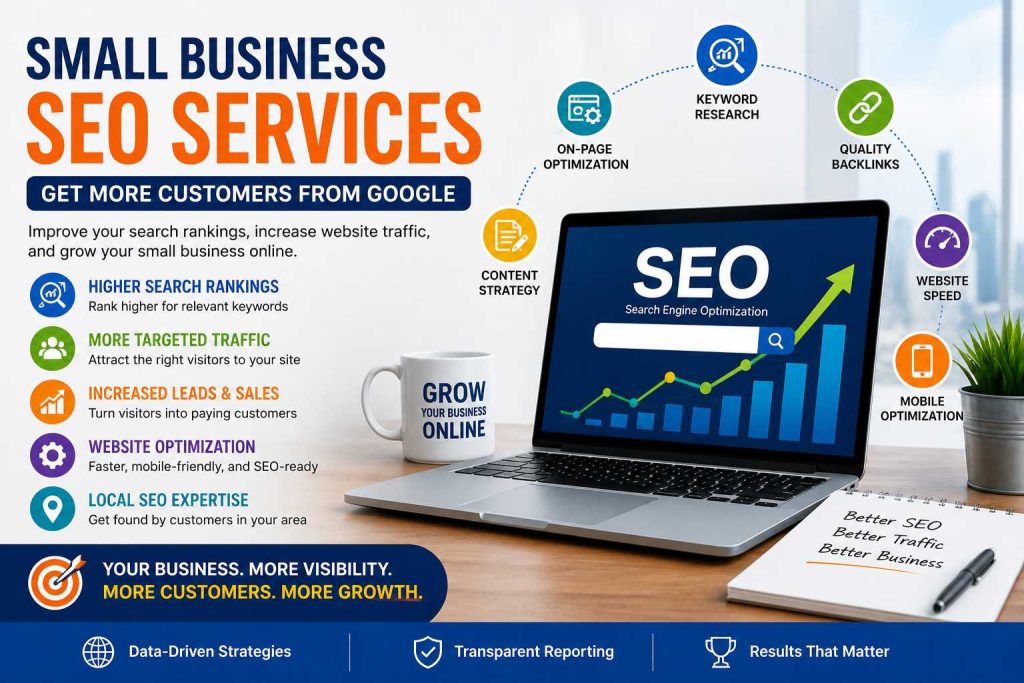
For many small businesses, getting more customers online has become increasingly important.
People search Google every day before choosing a service provider, buying a product, hiring a professional, or comparing local businesses.
A potential customer may search for:
- A web design company
- SEO services
- A local contractor
- A marketing agency
- A business consultant
- An eCommerce solution
- A professional service near them
The important question for a small business owner is:
Can potential customers find your business when they are actively looking for what you offer?
This is where small business SEO services can play an important role.
Search Engine Optimization is not simply about trying to rank a website for as many keywords as possible. A successful strategy focuses on making a business easier to discover while improving the quality, usefulness, and performance of its website.
For small businesses, this can create opportunities to reach people who already have an interest in their products or services.
What Are Small Business SEO Services?
Small business SEO services focus on improving a website’s visibility for searches that are relevant to the business and its customers.
Depending on the business, an SEO strategy may include:
- Keyword research
- Website optimization
- On-page SEO
- Technical SEO
- Content improvement
- Local SEO
- Internal linking
- Mobile optimization
- Website speed improvements
- Search performance monitoring
The right strategy depends on the type of business.
A local service company may need to focus heavily on local searches.
An online business may need to create useful content and optimize important service or product pages.
A business that serves clients nationwide may need a broader content and website strategy.
There is no single SEO strategy that works perfectly for every company.
Why SEO Matters for Small Businesses
Small businesses often compete against companies with larger marketing budgets.
Paid advertising can help generate traffic, but advertising costs can increase and traffic may decrease when campaigns stop.
SEO can help businesses build a longer-term digital foundation.
When a website contains useful information, clearly explains its services, and provides a good user experience, it can create more opportunities to be discovered through relevant searches.
SEO should therefore be viewed as more than a marketing activity.
It is also a process of improving your website for the people you want to serve.
1. Start With the Right Customer Search Intent
One of the biggest SEO mistakes is targeting keywords only because they have high search volume.
A keyword may attract thousands of visitors but still bring very few customers.
For example, someone searching:
What is SEO?
may simply be looking for information.
Someone searching:
Small business SEO services
may be researching professional help.
Someone searching:
Affordable SEO services for small business
may have an even stronger commercial interest.
The goal is not always to attract the largest possible number of visitors.
The goal is to attract visitors who are relevant to your business.
This is why search intent should be an important part of keyword research.
2. Optimize the Pages That Matter Most
A small business website does not need hundreds of pages to be useful.
Instead, focus on improving the pages that have the greatest business value.
These may include:
- Your homepage
- Main service pages
- Product pages
- Contact page
- Location pages
- Important landing pages
Every important page should answer a clear question:
Why should a visitor stay on this page and what information are they looking for?
A strong service page should clearly explain:
- What the service is
- Who it is designed for
- What problems it can help solve
- What the process may involve
- How a potential customer can take the next step
Clear information can improve the experience for visitors while making the purpose of a page easier to understand.
3. Create Content That Helps Your Customers
Content can be one of the most valuable long-term assets for a small business website.
But not every article needs to target the broadest possible keyword.
A better approach is to identify questions your potential customers actually ask.
For example, small business owners may want to know:
- How much does SEO cost?
- How long does SEO take?
- Why is my website not getting traffic?
- How can I improve my website ranking?
- What should I look for in an SEO company?
- Does my small business need local SEO?
- How can I get more customers from Google?
These questions can become useful articles, guides, FAQs, or service-page sections.
The best content should provide a genuine answer.
If a visitor finishes reading your article and still needs to immediately search elsewhere for basic information, the content may not be providing enough value.
4. Website Optimization Is an Important SEO Foundation
SEO is not only about content.
Your website should also provide a good experience.
Important areas to review include:
Website Speed
A website should load efficiently and avoid unnecessary delays.
Large images, unnecessary plugins, poorly optimized scripts, and weak hosting can affect website performance.
Mobile Experience
Many people search and browse on mobile devices.
Your content, navigation, forms, and buttons should be easy to use on smaller screens.
Clear Navigation
Visitors should be able to find important information without confusion.
Secure Website
A business website should use HTTPS and follow reasonable security practices.
Website optimization helps create a stronger foundation before expanding into more competitive content topics.
5. Local SEO Can Help Small Businesses Compete
For businesses serving customers in specific cities or regions, local SEO can be extremely important.
A local customer may search for:
- SEO services near me
- Web design company in my city
- Local marketing agency
- Small business services near me
Local SEO strategies may involve improving:
- Business information
- Location-related website content
- Google Business Profile
- Local citations
- Customer reviews
- Mobile usability
For many service businesses, local relevance can be more valuable than trying to compete immediately for extremely broad national keywords.
6. Build Trust Before Asking for the Sale
Visitors often research a business before contacting it.
Your website should help answer important trust questions.
Consider whether your website clearly provides:
- Information about your company
- The services you offer
- Ways to contact you
- Examples of work or experience
- Helpful educational content
- Clear business information
A professional website should not make visitors guess who they are dealing with.
Trust can be especially important when a customer is comparing several businesses.
7. Affordable SEO Does Not Mean Low-Quality SEO
Many small businesses look for affordable SEO services.
However, affordable should not mean using shortcuts that create long-term problems.
A sustainable SEO strategy should focus on improving the actual website.
This may involve:
- Creating better content
- Improving service pages
- Fixing technical problems
- Making the website easier to use
- Researching relevant customer searches
- Building a logical website structure
Businesses should be cautious about unrealistic promises such as guaranteed instant rankings.
SEO results can depend on competition, website quality, search intent, technical factors, and many other variables.
A realistic strategy focuses on continuous improvement.
8. Track What Is Actually Working
SEO should not be based entirely on assumptions.
Businesses should monitor relevant information over time.
Important questions include:
- Which pages are receiving search impressions?
- Which pages are attracting visitors?
- What search terms are relevant to the business?
- Which pages are generating inquiries?
- Where are visitors leaving the website?
- Which service pages need improvement?
Tracking performance can help businesses make better decisions about where to invest their time.
Instead of creating content randomly, businesses can improve pages and topics that show real potential.
How to Improve Small Business Website SEO
A simple process can help small businesses get started.
Step 1: Review Your Website
Look at your website from the perspective of a potential customer.
Can you immediately understand:
- What the company does?
- Who the company serves?
- Which services are available?
- How to contact the business?
Step 2: Identify High-Value Services
Choose the services that are most important to your business.
These services should have clear, useful, and well-organized pages.
Step 3: Research Customer Questions
Think about what potential customers search for before contacting you.
Use these questions to create genuinely helpful content.
Step 4: Improve Website Performance
Review mobile usability, page speed, images, plugins, and website structure.
Step 5: Build Content Consistently
Create useful content over time rather than publishing a large number of low-value articles.
Step 6: Review and Improve
SEO is an ongoing process.
Continue improving your best pages, updating outdated information, and identifying new customer questions.
When Should You Consider Professional Small Business SEO Services?
Managing SEO can require knowledge of website development, content, technical optimization, keyword research, and search performance.
Professional support may be useful when:
- Your website is not receiving relevant traffic
- Important service pages are not performing well
- You are unsure which keywords to target
- Your website has technical problems
- You do not have time to manage SEO consistently
- You need a structured strategy for long-term growth
The right SEO approach should focus on the needs and goals of the individual business rather than applying exactly the same strategy to every website.
Businesses looking for professional support with search optimization and website improvement can learn more about small business SEO and website optimization services from UpstairsBD.
Final Thoughts
Small businesses do not need to compete for every keyword on Google.
A better strategy is to focus on the searches that matter most to the business.
Start by understanding your customers.
Learn what problems they are trying to solve.
Improve the pages that are most important to your business.
Create useful content.
Make your website easier to use.
And continue improving over time.
SEO is not about finding a secret formula for instant rankings.
It is about building a website that deserves to be discovered.
When useful content, strong website optimization, clear services, and a positive user experience work together, a small business can create a stronger foundation for long-term online growth.
The goal is not simply more traffic. The goal is better visibility in front of the right customers.
You can also found our article published in this link.