

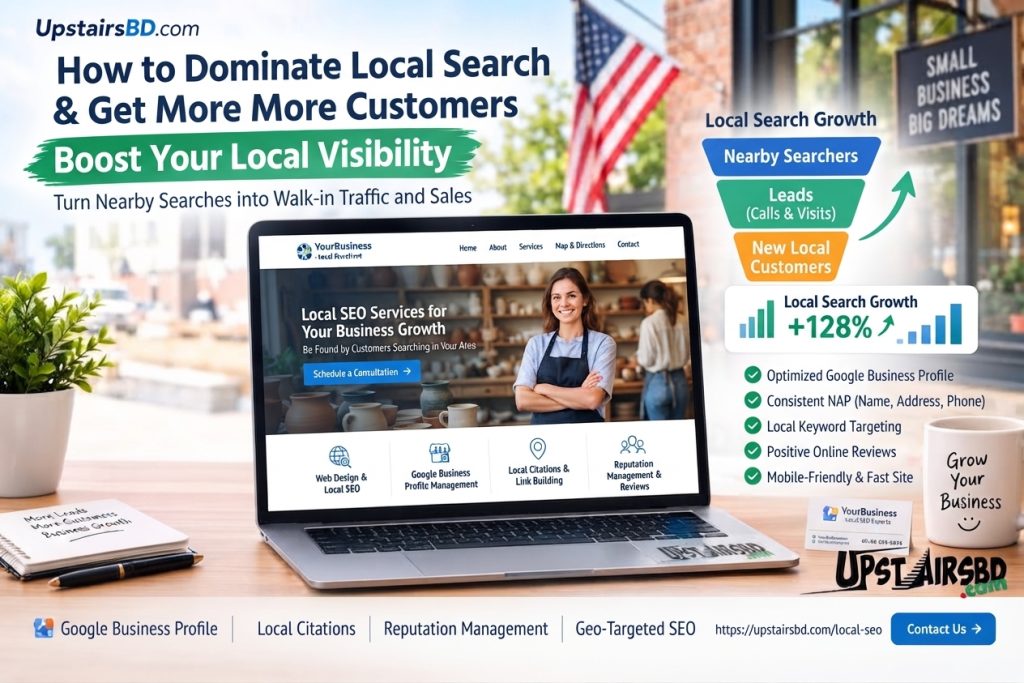
If you own a small business in the USA, having a website is only the beginning. Your potential customers are already searching Google for services, products, contractors, restaurants, consultants, agencies, and other local businesses. If your business does not appear when people search for what you offer, you may be missing valuable opportunities.
This is where local SEO for small businesses becomes important.
Local SEO helps businesses improve their visibility when people search for products or services in a specific geographic area. When done properly, it can help potential customers discover your website, business information, services, and contact details.
In this guide, we will explain what local SEO is, why it matters for small businesses, what you can do to improve your visibility, and how a strong website can support your local search strategy.
What Is Local SEO?
Local SEO is the process of improving your online presence so your business can become more visible for relevant searches with local intent.
For example, someone in Chicago might search:
- plumber near me
- Chicago web design company
- local accounting firm
- restaurant near me
- dentist in Chicago
- small business marketing agency
These searches can have strong commercial intent because the person may already be looking for a business to contact or purchase from.
Local SEO can involve several areas, including your website, business information, location signals, content, online profiles, reviews, technical SEO, and other factors that help search engines understand your business.
Why Local SEO Matters for Small Businesses
Large companies often have substantial marketing budgets and strong brand recognition. Small businesses usually need to compete by becoming highly relevant to the customers they actually want to reach.
A local SEO strategy can help your business become easier to discover when people search for services in your area.
For example, a local web development company may want to reach searches related to:
- WordPress developer
- website development
- business website design
- eCommerce website development
- SEO services
- website maintenance
Instead of trying to reach everyone, local SEO allows a business to focus on relevant customers and locations.
1. Create a Strong Business Website
Your website is one of the most important parts of your online presence.
A potential customer should be able to understand what your business does within a few seconds.
Your website should clearly communicate:
- What you offer
- Who you serve
- Where you operate
- Why customers should consider your business
- How customers can contact you
A professional website should also work properly on smartphones, tablets, and desktop computers.
If your website is difficult to navigate or important information is hard to find, visitors may leave before contacting you.
For businesses planning a new WordPress website, our guide on How to Choose the Best WordPress Developer for Your Business explains what to consider before hiring a developer.
2. Make Your Location and Service Areas Clear
Search engines need to understand where your business operates.
If you serve customers in specific cities, regions, or service areas, make that information clear where appropriate.
For example, a business might serve:
- New York City
- Los Angeles
- Houston
- Miami
- Chicago
- Dallas
However, avoid creating large numbers of low-quality location pages simply by changing the city name.
Each location page should provide genuinely useful information for people in that area.
Your goal should be to help customers, not simply create pages for search engines.
3. Optimize Your Google Business Presence
For eligible local businesses, maintaining accurate business information across Google’s business ecosystem is an important part of local visibility.
Your business information should be consistent and accurate.
Depending on your business, useful information may include:
- Business name
- Address
- Phone number
- Website
- Business category
- Business hours
- Services
- Photos
- Customer reviews
Keep your information updated whenever something changes.
Accurate business information can also make it easier for potential customers to contact you.
4. Use Local Keywords Naturally
Keywords help search engines understand the subject of your pages.
However, you should not repeat the same keyword unnecessarily.
For example, instead of writing:
“Best local SEO services for small businesses. Our local SEO services for small businesses provide local SEO services for small businesses…”
write naturally for your customers.
You can use phrases such as:
local SEO for small businesses
small business SEO services
local search optimization
SEO for local businesses
Use relevant terms in appropriate locations such as:
- Page titles
- Headings
- Introduction
- Service descriptions
- Image alt text when appropriate
- URLs
- Meta descriptions
- Body content
The primary goal should always be useful information rather than keyword repetition.
5. Create Helpful Local Content
A blog can help your business answer questions that potential customers are already asking.
For example, a local web development company could publish articles about:
- Website costs
- WordPress development
- Website redesign
- Website maintenance
- Local SEO
- Website speed
- Mobile-friendly websites
- eCommerce websites
- Google visibility
- Online marketing
Your content should answer real questions and provide practical information.
For example, instead of publishing a short article called “SEO Services,” you could create a detailed guide explaining how a small business can improve its online visibility.
This gives readers something useful while also demonstrating your knowledge.
6. Improve Your Website’s Technical SEO
Local SEO is not only about keywords.
Your website should also be technically accessible and easy to use.
Important areas include:
- Mobile usability
- Page speed
- Secure HTTPS
- Crawlable pages
- Logical website structure
- Descriptive URLs
- Proper headings
- Image optimization
- Internal links
- XML sitemap
- Appropriate structured data
Google’s documentation explains that technical requirements and search fundamentals are important for making content eligible to appear in Google Search.
Google also notes that good page experience includes areas such as Core Web Vitals, mobile usability, secure pages, and avoiding intrusive elements that interfere with the main content.
7. Build Useful Internal Links
Internal linking helps visitors discover related information on your website.
It can also help search engines understand the relationships between pages.
For example, a local SEO article can link to:
- Your SEO service page
- Your website development service
- Your WordPress articles
- Your website pricing guide
- Your website maintenance guide
- Your contact page
UpstairsBD already has related content about website pricing, website maintenance, WordPress development, and getting a small business website on Google. Linking these articles together creates a stronger content structure.
You can also read our guide:
How to Get Your Small Business Website on Google: A Practical SEO Guide
8. Encourage Genuine Customer Reviews
Customer reviews can help potential customers understand what it is like to work with your business.
Encourage satisfied customers to leave honest feedback on platforms where your business has a legitimate presence.
Do not create fake reviews or manipulate customer feedback.
Instead, provide a good customer experience and make it easy for genuine customers to share their experiences.
Detailed customer feedback can also help future customers understand your services.
9. Keep Your Business Information Consistent
Consistency matters when you publish business information online.
Pay attention to:
- Business name
- Phone number
- Website address
- Physical address
- Service information
- Business hours
If different websites contain conflicting information, customers may become confused.
Create a standard version of your business information and use it consistently where appropriate.
10. Optimize Your Service Pages
Many small businesses focus heavily on their homepage while neglecting their individual service pages.
That can be a missed opportunity.
If you provide several services, consider creating useful pages for each major service.
For example:
Website Design & Development
WordPress Development
SEO Services
E-Commerce Development
Website Maintenance
Each page should clearly explain:
- What the service includes
- Who the service is for
- Problems it solves
- Benefits
- Frequently asked questions
- How customers can get started
This gives search engines and customers more specific information about what your business provides.
11. Improve Your Website’s Page Experience
Getting visitors to your website is only part of the process.
Visitors also need a good experience after they arrive.
Check whether your website:
- Loads efficiently
- Works on mobile devices
- Has readable text
- Uses clear navigation
- Provides obvious contact options
- Avoids distracting elements
- Makes important information easy to find
Google explains that page experience is broader than a single ranking signal and that site owners should consider the overall experience rather than focusing on only one metric.
12. Use Structured Data Where Appropriate
Structured data can help search engines better understand the content and entities represented on a webpage.
Google supports several structured data types, including Article and LocalBusiness markup.
For example, an appropriate business website may use organization or local business information that accurately represents the real business.
However, structured data should describe information that actually exists on the page and should follow Google’s guidelines.
It is not a shortcut to guaranteed rankings.
13. Publish Content That Demonstrates Real Expertise
A successful local SEO strategy is not simply about publishing dozens of articles.
Your content should provide useful answers.
Consider creating content based on questions your customers ask before contacting you.
For example:
- How much does a small business website cost?
- How long does a WordPress website take to build?
- How can I improve my website speed?
- How can my business appear on Google?
- What does website maintenance include?
- How does local SEO work?
- Should my business use WordPress?
This type of content can attract people who are researching a purchase or service.
14. Connect Your Content With Your Services
Your blog should support your business.
If you offer SEO services, your SEO articles should naturally help readers discover your SEO service page.
If you offer WordPress development, relevant WordPress articles can link to your development service.
This creates a simple path:
Search → Helpful Article → Service Page → Contact → Potential Customer
The links should be relevant and useful rather than forced.
15. Do Not Expect Instant SEO Results
SEO is not an instant traffic system.
A new article may take time to be discovered, indexed, and evaluated by search engines.
Competition also varies significantly between keywords and locations.
Instead of expecting every article to rank immediately, build a useful collection of content around closely related topics.
Monitor your performance using tools such as Google Search Console and improve pages based on actual search data.
Google provides Search Console resources for monitoring search performance and checking whether Google can index your website.
A Simple Local SEO Strategy for a Small Business
A practical strategy can look like this:
Step 1: Define Your Target Customer
Decide exactly who you want to reach.
For example:
Small businesses in the USA that need professional websites and SEO services.
Step 2: Choose Relevant Services
Identify your most important services.
For example:
- WordPress development
- Website design
- SEO
- Website maintenance
- eCommerce development
Step 3: Research Search Intent
Find questions your potential customers are asking.
Then create genuinely useful content that answers those questions.
Step 4: Improve Your Website
Make sure your website is:
- Mobile-friendly
- Fast
- Secure
- Easy to navigate
- Easy to contact
- Search-engine accessible
Step 5: Build Internal Links
Connect related articles and service pages.
Step 6: Monitor Search Performance
Use Google Search Console to understand:
- Impressions
- Clicks
- Search queries
- Average position
- Pages receiving traffic
Then improve content based on what you learn.
Common Local SEO Mistakes to Avoid
Keyword Stuffing
Repeating keywords excessively can make content difficult to read.
Write for people first.
Creating Thin Location Pages
Do not create dozens of nearly identical pages with only the city name changed.
Each page should have a real purpose and useful information.
Ignoring Mobile Users
Many customers search from smartphones.
Your website should provide a comfortable mobile experience.
Publishing Without Internal Links
Your articles should connect logically to other useful pages.
Buying Low-Quality Links
Avoid questionable link-building tactics that can create long-term problems.
Focus on useful content, legitimate relationships, and genuine visibility.
Expecting One Article to Generate Huge Traffic
SEO usually works better as a long-term content system.
One useful article can become part of a larger group of related pages.
How UpstairsBD Can Help Your Business
At UpstairsBD.com, we provide website development, SEO, eCommerce solutions, digital marketing, graphic design, video editing, and related digital services.
Our goal is to help businesses build a professional online presence with websites that are designed around their business needs.
If your business needs a new website, WordPress development, SEO support, or website improvements, you can explore our services and contact our team.
You can also read our guide:
How Much Does a WordPress Website Cost in the USA? A Complete Pricing Guide
Frequently Asked Questions
What is local SEO for small businesses?
Local SEO is the process of improving a business’s online presence so it can become more visible for relevant searches with local intent.
Is local SEO useful for small businesses?
Local SEO can help small businesses become more discoverable when potential customers search for relevant products or services in their area.
How can I improve my local SEO?
Start with a useful website, accurate business information, relevant content, strong service pages, mobile-friendly design, technical SEO, internal linking, and a consistent online presence.
How long does local SEO take?
There is no universal timeframe. Results can depend on competition, website quality, content, authority, location, search intent, and the condition of the existing website.
Can a small business rank on Google without a large marketing budget?
Small businesses can compete in search, but results vary by market and query. A focused strategy can help a business concentrate resources on relevant customers and useful search topics.
Should local SEO be combined with website development?
Yes. A technically sound, useful website provides an important foundation for SEO. However, website development alone does not guarantee search rankings.
Final Thoughts
Local SEO gives small businesses an opportunity to improve their visibility when potential customers search for relevant products and services.
The process starts with a professional website and accurate business information. From there, businesses can build useful service pages, publish helpful content, improve technical SEO, strengthen internal linking, maintain a good mobile experience, and monitor their search performance.
The most important principle is simple:
Create a website that genuinely helps your customers, then make it easier for search engines to understand and discover that website.
If you are ready to improve your website and online visibility, visit UpstairsBD.com or contact UpstairsBD to discuss your project.