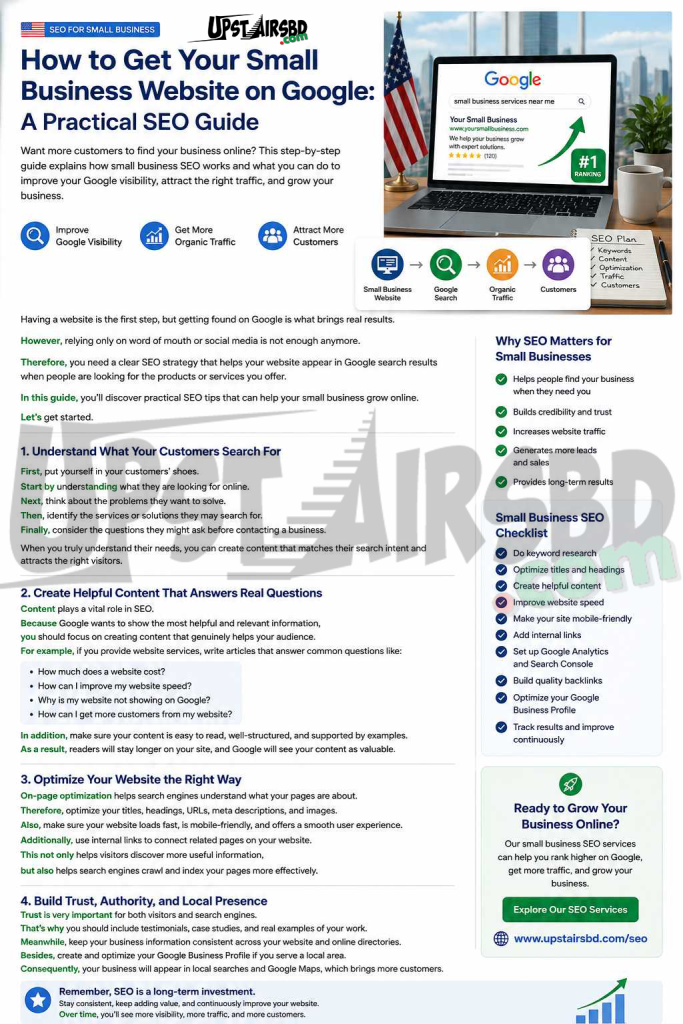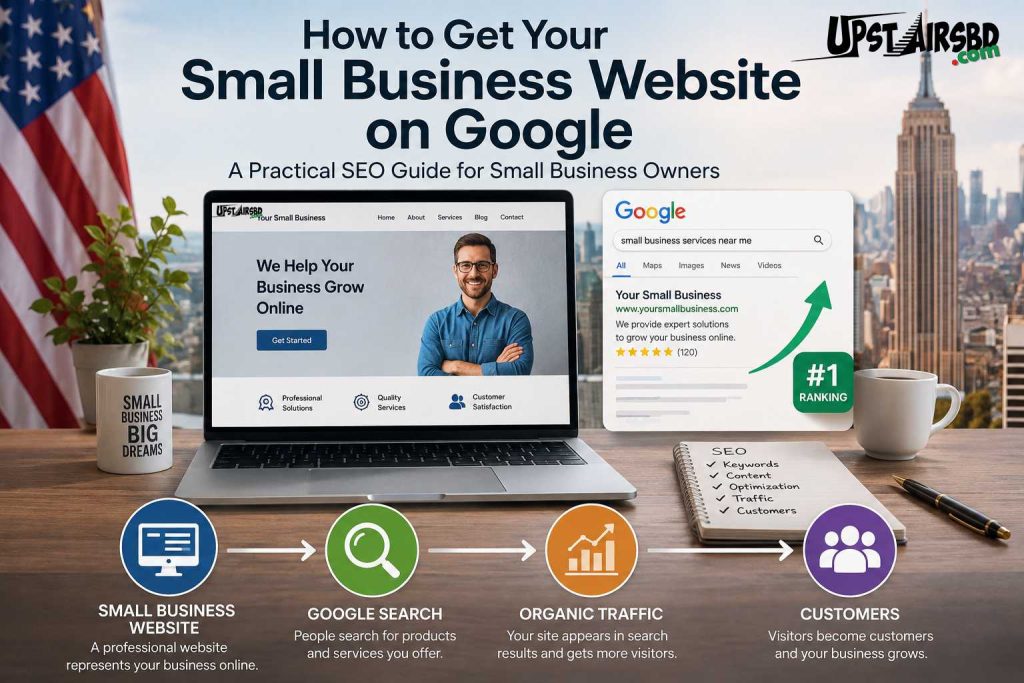
Having a website is no longer enough for a small business without SEO.
Your website may look professional, explain your services, and provide your contact information. But if potential customers cannot find it when they search Google, it may not generate the results you expect.
A common question among business owners is:
“How can I get my small business website on Google?”
The answer involves more than simply submitting a website to a search engine.
A successful small business SEO strategy combines a technically sound website, useful content, relevant keywords, strong website structure, good user experience, and ongoing improvement.
The good news is that small businesses do not necessarily need a huge marketing budget to start improving their search visibility.
What they need is the right strategy.
What Does It Mean to Get Your Website on Google?
When people say they want their website “on Google,” they may mean several different things.
Your website can potentially appear when someone searches for:
- Your business name
- Your products or services
- Questions related to your industry
- Local services
- Problems your business can solve
However, simply appearing somewhere in search results is not enough.
Ideally, your website should appear for searches that are relevant to your business and valuable to your potential customers.
For example, a website selling professional accounting services would benefit more from attracting people searching for accounting services than from receiving thousands of visitors looking for unrelated information.
Therefore, SEO should focus on relevant visibility, not just traffic volume.
1. Make Sure Google Can Understand Your Website
Before worrying about rankings, start with the foundation.
Search engines need to be able to discover, crawl, and understand your website.
Your website should have:
- Clear navigation
- Logical page structure
- Descriptive page titles
- Useful headings
- Search-friendly URLs
- Mobile-friendly pages
- Accessible content
- A secure HTTPS connection
A technically confusing website can make it harder for both visitors and search engines to understand its content.
For this reason, technical website optimization should be one of the first steps in your SEO strategy.
2. Identify What Your Customers Search For
One of the most important parts of SEO is understanding search intent.
Think about your potential customers.
Start by understanding what your potential customers are looking for online.
Next, consider the problems they are trying to solve.
Then, identify the services they may be searching for.
Finally, think about the questions they might ask before contacting a business.
For example, a small business owner looking for website help might search for:
- Website development company
- WordPress website designer
- Small business website design
- Affordable website development
- SEO services for small business
These searches reveal something important: the person already has a specific need.
Your website should create useful pages that address those needs.
3. Create Dedicated Service Pages
One of the common mistakes small businesses make is putting all their services on one page.
A better approach is often to create dedicated pages for important services.
For example, a digital services company could have:
- WordPress Development
- SEO Services
- Website Design
- eCommerce Development
- Website Maintenance
Each page can explain the service in detail.
A dedicated service page also gives you an opportunity to target relevant search queries naturally.
For example, instead of trying to rank one generic “Services” page for everything, you can create a useful page specifically focused on your SEO services.
This creates a clearer relationship between the customer’s search and the page they land on.
4. Write Content That Answers Real Questions
Content is one of the most powerful tools available to small businesses.
However, publishing articles simply to increase the number of pages on your website is not enough.
Your content should solve problems.
For example, if you provide website development services, useful articles could answer:
- How much does a website cost?
- What does a small business website need?
- Should a small business use WordPress?
- Why is my website not getting traffic?
- How can I improve my website speed?
- How can I get more customers from Google?
These topics can attract people who are researching a problem that your business may be able to solve.
A useful rule:
Don’t write for search engines first. Write for the person who performed the search.
When the content is genuinely useful, SEO becomes much more natural.
5. Optimize Your Page Titles and Headings
Every important page should have a clear topic.
Your page title should communicate what the page is about.
For example:
Weak:
Services
Better:
Small Business SEO Services
Similarly, headings should organize the content into logical sections.
A well-structured article might use:
H1
How to Get Your Small Business Website on Google
H2
What Does It Mean to Get Your Website on Google?
H2
How to Choose the Right SEO Keywords
H2
How to Improve Your Website
H2
How to Create Helpful Content
This makes the article easier for visitors to scan and understand.
6. Improve Your Website Speed
Nobody enjoys waiting for a slow website.
A slow website can create a poor experience, particularly for people browsing on mobile devices.
Several factors can affect website performance, including:
- Large images
- Excessive plugins
- Heavy themes
- Unoptimized scripts
- Poor hosting configuration
- Unnecessary third-party services
Therefore, website speed should be part of your SEO and website improvement strategy.
Start by optimizing large images and reviewing unnecessary plugins.
Then monitor your website performance regularly.
7. Make Your Website Mobile-Friendly
Your potential customers may visit your website from:
- Smartphones
- Tablets
- Laptops
- Desktop computers
Your website should work properly across different screen sizes.
Mobile visitors should be able to:
- Read your content
- Navigate your pages
- Click buttons
- Complete contact forms
- Find your business information
A website that looks excellent on a desktop but is difficult to use on a phone can lose potential customers.
For this reason, responsive design is an important part of modern website optimization.
8. Use Internal Links
Internal links connect pages on your own website.
They can help visitors discover related information and create a more organized website structure.
For example, this article could naturally link to:
- Your SEO services page
- Your WordPress services page
- Your website development page
- A related website-cost article
Suppose someone reads an article about small business SEO.
A relevant link to your SEO service page gives that reader an opportunity to learn about the professional service you provide.
That is much more useful than adding random links.
Internal links should always have a purpose.
9. Optimize Images
Images can improve an article and make information easier to understand.
However, large image files can also affect performance.
Before uploading an image:
- Resize it appropriately
- Compress the file
- Use a suitable image format
- Add descriptive alternative text when appropriate
For example, an image showing an SEO dashboard could use descriptive alt text such as:
Small business SEO dashboard showing website traffic and search visibility
Avoid stuffing multiple keywords into every image’s alt text.
Descriptions should accurately represent what the image contains.
10. Build a Strong Local SEO Foundation
If your business serves a particular geographic area, local SEO can be extremely valuable.
People frequently search for businesses using location-related queries.
Examples include:
- Web designer near me
- SEO company near me
- Website development company in my city
- Local SEO services
Make sure your business information is accurate and consistent across relevant online platforms.
A complete and trustworthy business presence can help potential customers understand:
- Who you are
- What you offer
- Where you operate
- How they can contact you
11. Build Trust With Useful Information
Ranking in Google is important.
However, getting someone to trust your business after they arrive at your website is equally important.
Your website should clearly communicate:
- What your company does
- Who you serve
- What services you provide
- How people can contact you
- Why customers should consider your business
You can also build trust through:
- Helpful articles
- Case studies
- Portfolio examples
- Testimonials
- Clear business information
- Professional website design
The visitor should not have to search through your website to understand what your business actually does.
12. Don’t Try to Rank for Everything
This is especially important for small businesses.
You do not need to rank for every possible keyword.
Instead, focus on topics that are closely connected to your customers and services.
For example, a website development company could focus on:
Primary topics
- WordPress website development
- Small business website design
- SEO services
- Website optimization
Supporting topics
- WordPress website cost
- Website speed
- SEO basics
- Website conversion
- Local SEO
This creates a stronger relationship between your content and your services.
13. Keep Improving Existing Content
SEO isn’t finished when you publish an article.
Over time, you may discover that:
- A page receives impressions but few clicks
- An article ranks for unexpected keywords
- A page needs more information
- A title could be improved
- Some information has become outdated
Instead of constantly creating new articles, sometimes the better strategy is to improve content that already has potential.
This can be especially valuable for pages that are already receiving search impressions.
14. Monitor Your Google Search Performance
One of the most useful tools for website owners is Google Search Console.
It can help you understand how your website performs in Google Search.
You can monitor:
- Search impressions
- Clicks
- Click-through rate
- Average position
- Search queries
- Top-performing pages
- Country performance
For your USA traffic strategy, pay particular attention to United States traffic.
If you begin seeing impressions from US searches, that gives you valuable information about which topics Google associates with your website.
You can then create better content around those topics.
How Long Does Small Business SEO Take?
This is one of the most common questions business owners ask.
SEO is not normally an instant marketing method.
The timeline can depend on factors such as:
- Website history
- Competition
- Content quality
- Technical condition
- Search intent
- Website authority
- Industry
- Consistency of optimization
Some pages may begin receiving impressions relatively quickly, while competitive keywords can take considerably longer.
Therefore, it is better to think of SEO as a long-term investment in your website rather than a quick advertising campaign.
Should You Hire a Small Business SEO Company?
Some business owners prefer to manage SEO themselves.
That can work when they have enough time and knowledge.
However, professional SEO support may be useful when:
- Your website receives little organic traffic
- You don’t know which keywords to target
- Your website has technical issues
- Your important pages aren’t performing
- You don’t have time to manage content
- You want a structured SEO strategy
A good SEO provider should focus on improving the actual website rather than making unrealistic promises.
Be cautious of anyone promising guaranteed #1 Google rankings.
SEO involves many variables, and no legitimate provider can control Google’s ranking system.
A Simple Small Business SEO Checklist
Before launching your SEO campaign, review these areas:
Website
- Is your website mobile-friendly?
- Is navigation easy?
- Does the website load efficiently?
- Is HTTPS enabled?
Content
- Does each important page have a clear purpose?
- Does your content answer real customer questions?
- Are your service pages detailed and useful?
Keywords
- Are you targeting relevant searches?
- Does each page have a primary topic?
- Are keywords used naturally?
Technical SEO
- Can search engines discover your important pages?
- Are there broken links?
- Are unnecessary plugins or scripts affecting performance?
Local SEO
- Is your business information accurate?
- Is your location clear where relevant?
- Are your local profiles complete?
Measurement
- Have you connected Google Search Console?
- Are you monitoring impressions and clicks?
- Are you checking which pages attract search traffic?
Final Thoughts
Getting a small business website onto Google is not about finding one magic keyword.
It is about building a website that deserves to be found.
Start with a strong technical foundation.
Understand what your customers search for.
Create useful service pages.
Publish genuinely helpful content.
Improve website speed and mobile usability.
Connect related pages with internal links.
Build trust.
Then monitor your results and continue improving.
For small businesses, SEO is a long-term process rather than a one-time task.
The objective should not simply be to generate thousands of random visitors.
The real goal is to attract the right people—people who are searching for the products, services, and solutions your business provides.
If your website consistently helps those people, search visibility can become a valuable source of long-term business growth.