

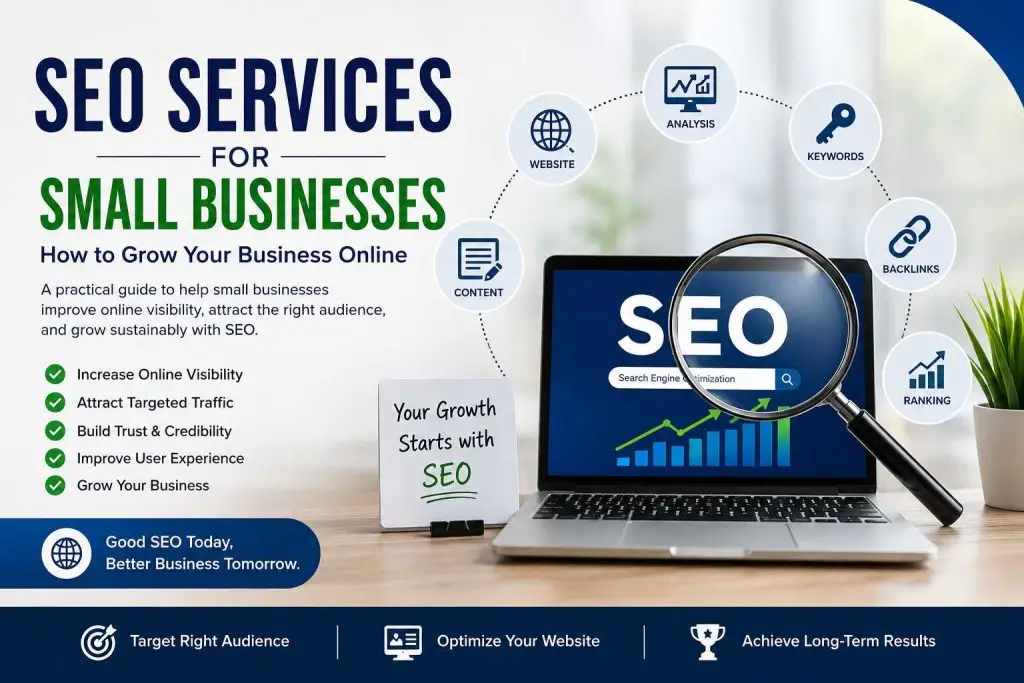
Today, customers search online before choosing a product, service, restaurant, agency, consultant, or local business. They compare options, read information, and often make their decisions before directly contacting a company.
This creates an important question for every small business owner:
Having a website is an important first step, but simply publishing a website does not automatically bring visitors. Your website needs useful content, a clear structure, good technical performance, and a strategy that helps search engines understand what your business offers.
This is where Search Engine Optimization, commonly known as SEO, can play an important role.
What Is SEO and Why Does It Matter for Small Businesses?
SEO is the process of improving a website so that search engines can better understand its content and users can more easily discover it through relevant searches.
For a small business, SEO can help create opportunities to reach people who are already looking for related products or services.
For example, potential customers may search for:
- Website design services
- SEO services
- WordPress developers
- Digital marketing solutions
- Local professional services
- e-Commerce websites
- Business technology solutions
If your website provides useful and relevant information related to these searches, it may have a better opportunity to appear in search results over time.
SEO is not an instant solution, and there is no guaranteed position in search results. However, a consistent and well-planned SEO strategy can help a business build stronger long-term online visibility.
1. Your Website Should Clearly Explain Your Business
One of the most important questions a visitor should be able to answer quickly is:
What does this business do?
Your website should clearly communicate:
- What services or products you provide
- Who your services are designed for
- What problems you can help solve
- How customers can contact you
Many small businesses make the mistake of creating a website that looks attractive but does not clearly explain its value.
A professional design is important, but clarity is equally important.
Your homepage, service pages, and important landing pages should help visitors understand your business without making them search through multiple pages.
2. Start With the Questions Your Customers Actually Ask
Good SEO begins with understanding your audience.
Instead of thinking only about which keywords you want to rank for, think about the questions your potential customers may ask.
For example, a business looking for SEO support might search for questions such as:
- How can I improve my website ranking?
- Why is my website not getting traffic?
- How do SEO services work?
- How can a small business get more online customers?
- What should I improve on my business website?
These questions can become useful topics for website pages, blog articles, guides, and frequently asked questions.
When your content genuinely answers relevant questions, it can become more useful to visitors while also helping search engines understand the purpose of your website.
3. Focus on Quality Content, Not Just Keywords
In the past, some websites attempted to improve rankings simply by repeating keywords many times.
Modern SEO requires a better approach.
Keywords are still useful because they help communicate the topic of a page. However, they should appear naturally within useful content.
A strong page should be written for people first.
For example, instead of repeatedly writing:
best SEO services for small business best SEO company SEO expert SEO services
A better approach is to explain:
- What SEO services involve
- Which website areas may need improvement
- How keyword research works
- Why technical SEO matters
- How useful content supports online visibility
- Why results can take time
Useful content creates a better experience for readers and helps build credibility.
4. Make Your Website Mobile-Friendly
A large percentage of website visitors now use mobile devices.
Your website should provide a smooth experience on:
- Mobile phones
- Tablets
- Laptops
- Desktop computers
A mobile visitor should be able to easily:
- Read your content
- Navigate your website
- View your services
- Complete a contact form
- Call or message your business
If users struggle to use your website, they may leave before learning what your business can offer.
A responsive and user-friendly website is therefore an important part of building a strong online presence.
5. Improve Website Speed and Performance
Website performance affects user experience.
Visitors generally expect websites to load and respond smoothly. A slow or poorly optimized website can make it difficult for users to access information.
Small businesses should regularly review areas such as:
- Image sizes
- Unnecessary plugins
- Website hosting performance
- Mobile optimization
- Theme performance
- Unused scripts and files
Improving technical performance can help create a smoother experience for visitors and provide a stronger foundation for SEO.
6. Create Useful Service Pages
A common mistake is putting all business information on one homepage.
Instead, important services should usually have their own dedicated pages.
For example, a digital agency may have separate pages for:
- WordPress Website Development
- Search Engine Optimization
- eCommerce Website Development
- Website Maintenance
- Graphic Design
- Digital Marketing
Dedicated service pages allow you to explain each service in more detail.
They can include:
- A clear description of the service
- Who the service is for
- Benefits and expected outcomes
- The process involved
- Frequently asked questions
- Examples of relevant work
This structure can make your website more useful for both visitors and search engines.
7. Build Trust Through Your Website
Customers often research a business before contacting it.
Your website can help build trust by clearly providing information about your business.
Consider including:
- An About page
- Clear service descriptions
- Contact information
- Portfolio or project examples
- Testimonials, where genuine and appropriate
- Business information
- Useful educational content
Trust is especially important for small businesses that are competing with larger and more established brands.
A clear and professional website can help create a stronger first impression.
8. Use Links Naturally and Meaningfully
Links can help visitors discover additional information.
For example, if you publish an article about improving website visibility, you might link to a detailed page about your SEO services.
The link should be relevant to the topic and useful for the reader.
For businesses looking for more information about professional SEO strategies and website optimization, you can learn more through SEO Services by UpstairsBD.
The goal should always be to provide additional value and context rather than adding links unnecessarily.
9. SEO Is a Long-Term Business Strategy
One of the most important things small business owners should understand is that SEO takes time.
Search visibility can depend on many factors, including:
- Competition
- Website quality
- Content relevance
- Technical performance
- Website structure
- Search engine crawling and indexing
- User needs and search intent
Some improvements may take time to be reflected in search results.
For this reason, SEO should be viewed as an ongoing process rather than a one-time task.
Businesses can regularly improve their websites by:
- Updating outdated information
- Creating useful new content
- Improving important pages
- Fixing technical problems
- Reviewing user experience
- Monitoring website performance
Consistency can be more valuable than searching for shortcuts.
How Can Small Businesses Start Improving Their SEO?
A practical starting point can be divided into several steps.
Step 1: Review Your Website
Look at your website as if you were a new customer.
Ask yourself:
- Is it clear what my business does?
- Can visitors easily find my services?
- Is the website easy to use on mobile?
- Does the website load reasonably well?
- Is important information easy to find?
Step 2: Identify Your Important Pages
Decide which pages are most valuable to your business.
These might include:
- Homepage
- Core service pages
- Contact page
- Location or business information pages
- Important product pages
Focus on making these pages clear, useful, and complete.
Step 3: Understand Your Audience
Think about what your customers search for before they contact a business like yours.
Create content that answers real questions and addresses real problems.
Step 4: Improve Your Content
Make sure your content is:
- Clear
- Original
- Useful
- Easy to read
- Well organized
- Relevant to your business
Step 5: Continue Improving
SEO is not something that should be completely forgotten after a website is launched.
Review your website regularly and continue improving areas that can provide more value to your visitors.
Final Thoughts
Small businesses do not always need the largest marketing budget to improve their online presence.
A clear website, useful content, good user experience, and a consistent SEO strategy can help create opportunities for long-term growth.
The goal of SEO should not simply be to appear higher in search results.
The bigger goal should be to create a useful online presence that helps the right people discover your business and understand how you can help them.
Start by improving your website for your customers.
Create content that answers their questions.
Make your services easy to understand.
Build trust.
Improve continuously.
Over time, these efforts can create a stronger foundation for sustainable online visibility.
Your website is more than an online brochure. With the right strategy, it can become an important part of your business growth.